
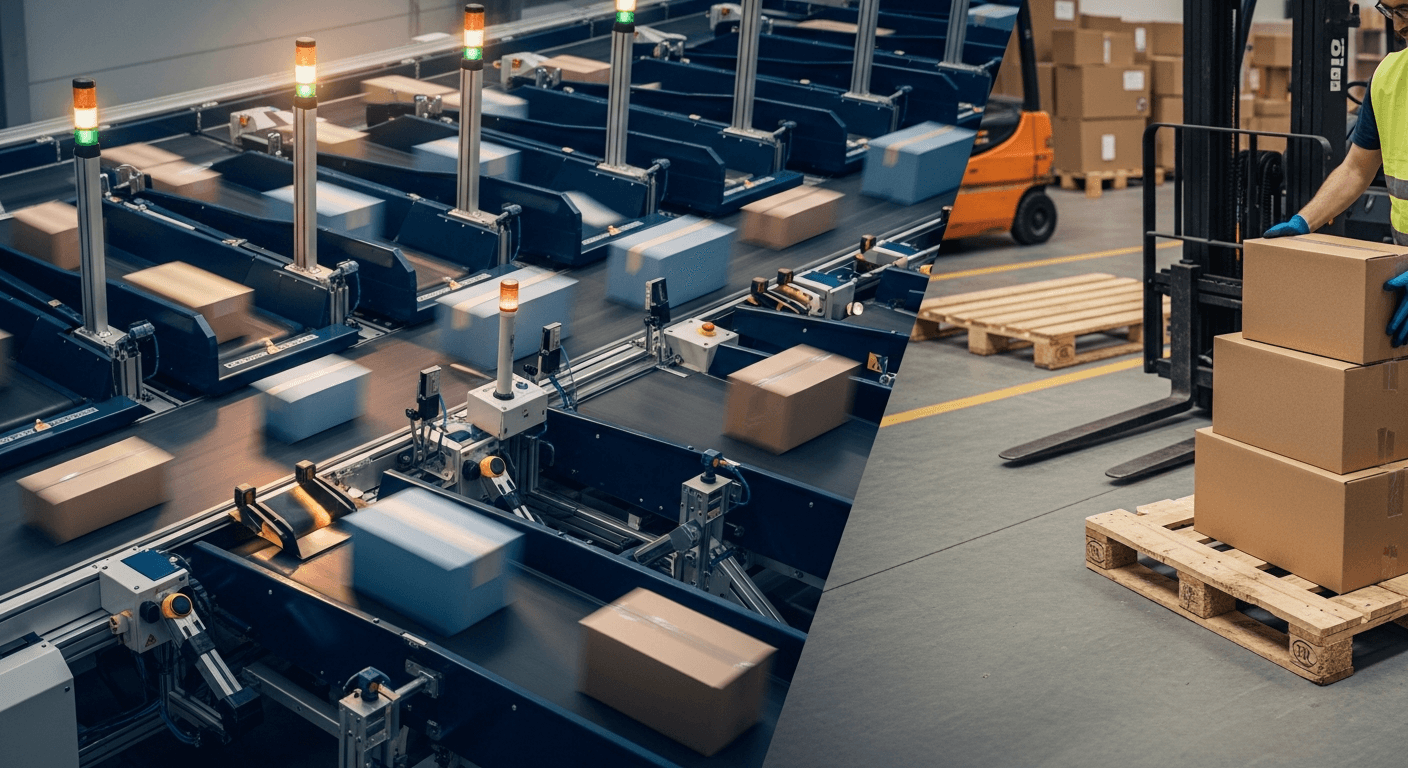
Fast Fulfillment vs Traditional Fulfillment Models
The 3PL industry is bifurcating. On one side: traditional fulfillment models designed for wholesale, B2B, and batch processing. On the other: fast fulfillment models built from the ground up for e-commerce speed and consumer expectations. Understanding the difference matters for every brand choosing a fulfillment partner.
What Is Traditional Fulfillment?
Traditional fulfillment models were designed for a different era of commerce, one where orders came in by fax or EDI, shipped in pallets to retail stores, and transit times were measured in weeks.
These models prioritize cost-per-pallet-move over cost-per-order. They're optimized for volume receiving, long-term storage, and LTL/FTL shipments to wholesale accounts. They can process B2B orders efficiently, but they often struggle with the velocity, variability, and customer expectations of modern e-commerce.
What Is Fast Fulfillment?
Fast fulfillment is a model designed for e-commerce. The core metrics are different: speed per order, order accuracy, platform integration depth, and same-day processing rate.
A fast fulfillment operation is built around the assumption that orders come in continuously throughout the day, from Shopify, Amazon, WooCommerce, and dozens of other channels, and that every order needs to ship same-day if received before the cutoff.
Traditional vs. Fast Fulfillment: Side by Side
| Dimension | Traditional Fulfillment | Fast Fulfillment |
|---|---|---|
| Primary customer | Wholesale/B2B | E-commerce/DTC |
| Order type | Pallets to stores | Parcels to consumers |
| Processing model | Batch/scheduled | Continuous, real-time |
| Same-day shipping | Uncommon | Standard commitment |
| Platform integrations | EDI/manual | Native API, real-time |
| Order accuracy | Pallet-level | Item-level, barcode-scanned |
| Inventory visibility | Periodic | Real-time |
| Support model | Account rep | Dedicated on-site team |
The Technology Gap
Perhaps the most significant difference between traditional and fast fulfillment is technology. Traditional 3PLs often rely on WMS platforms built in the 1990s or 2000s, with EDI as the primary integration method, designed for a world of purchase orders, not API calls.
Fast fulfillment platforms integrate natively with modern e-commerce: Shopify, Amazon Seller Central, WooCommerce, BigCommerce, TikTok Shop. Orders flow in automatically, inventory syncs in real time, and fulfillment begins the moment the customer checks out.
Location as a Speed Multiplier
Fast fulfillment isn't just about warehouse operations, geography matters too. A warehouse in the center of the country maximizes the reach of same-day shipping commitments. From Kansas City, same-day processing combined with 2-day ground shipping delivers to over 70% of the U.S. population the next business day.
This geographic positioning is as important as operational speed. A warehouse that ships same-day from a coastal location still imposes 5 to 6 day transit times on half the country.
Which Model Is Right for Your Brand?
If your business is primarily wholesale or B2B, a traditional fulfillment model may serve you well. But if you're primarily shipping direct-to-consumer orders across multiple e-commerce channels, you need a fast fulfillment partner.
The risks of choosing a traditional model for e-commerce: order processing delays, no real-time inventory visibility, poor integration support for modern platforms, and support structures designed for large accounts rather than high-frequency DTC brands.
Fast Fulfillment: Built for E-Commerce Speed
Fast Fulfillment was purpose-built for the fast fulfillment model. Same-day processing. Native platform integrations. Real-time inventory visibility. Central U.S. location for nationwide coverage.
See Why We're the Fastest Fulfillment Company →